
The Market
10+ Years Of Historical Data
See how volatility products behaved across multiple market cycles.

For Accredited Investors
An Exclusive Investment Vehicle — Backed By 10+ Years Of Historical Market Data And Third-Party Audited Results
Learn how the strategy works, see the evidence behind it, and determine whether it makes sense for your portfolio.

0+15+ Years
Historical Market Data
Third-Party Audited
Independently audited fund results.
FINRA-Verifiable
David Meyers, verifiable public record.
Institutional Infrastructure
Brokerage • Custody • Administration.
So Where Does The Return Come From?
“Contango is the lead cause of structural decay in volatility ETPs like UVXY that track the VIX index. Over the last year the VIX ended roughly where it started, while UVXY lost about 71% of its value.”
That gap is the opportunity.
But what does this actually mean?
To understand the gap, you first need to understand 4 simple layers:

Private Consultation
Join a private investor briefing and we'll walk you through:



Now here’s where it gets interesting.
UVXY is designed to track volatility — but because of these layers, it doesn’t behave like the VIX over time.
VIX vs UVXY
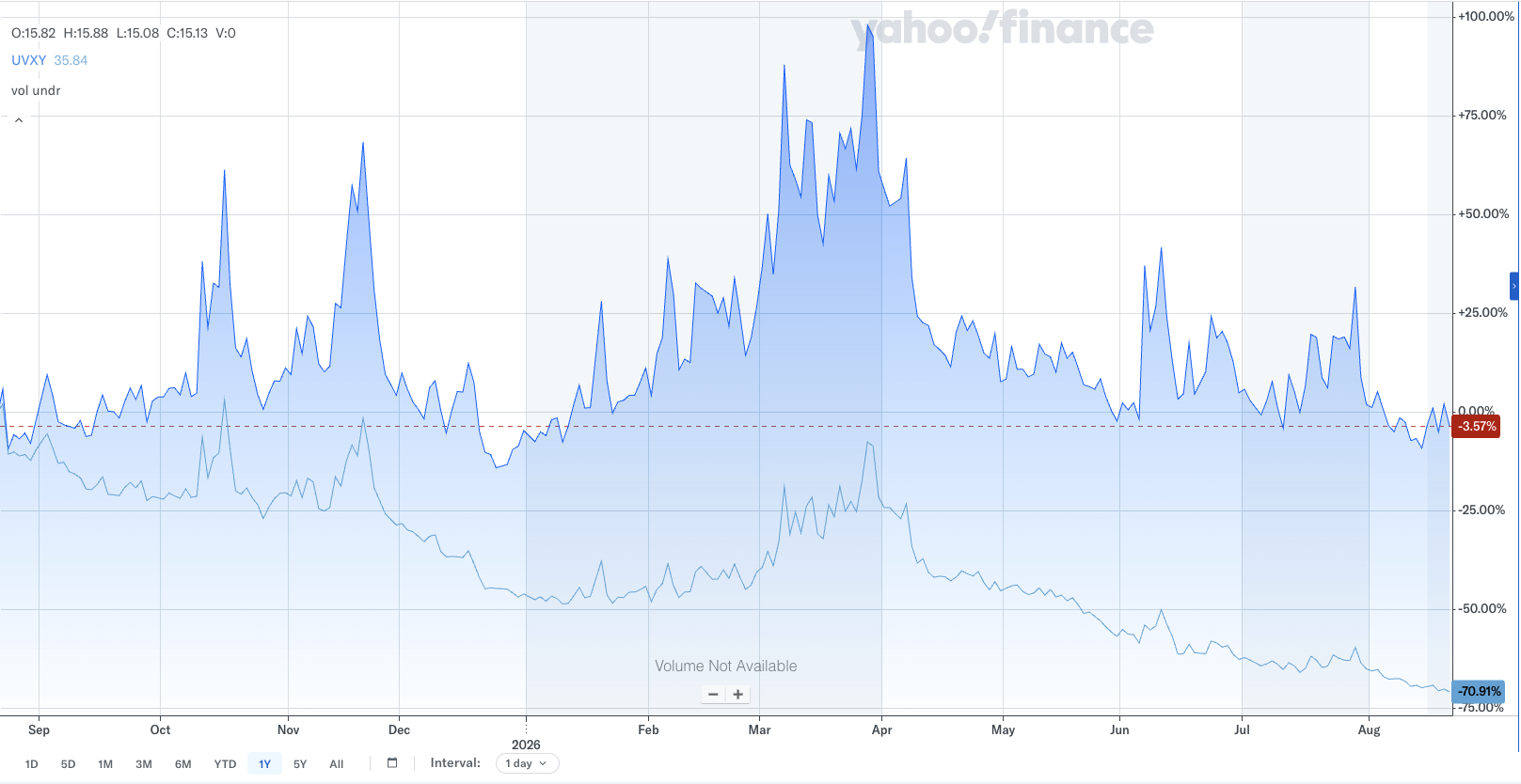
The Effect Of Structural Decay
Remember the gap we started with?
Over the last year, the VIX ended roughly where it started.
UVXY lost about 71% of its value.
VIX
−3.57%
UVXY
−70.91%
Both are tied to the same volatility market — the difference is created by the structure itself.
So Where Does That 71% Gap Come From?
It's not one thing. Contango and rolling are the biggest drivers — but leverage, rebalancing, mean reversion and the cost of maintaining the position all contribute to the decay.
Why UVXY Loses Value Over Time
Investors pay a premium for protection against future uncertainty, so later VIX futures often cost more than nearer ones. This is called Volatility Risk Premium.
But futures expire, and UVXY needs constant volatility exposure. So it has to continually replace expiring contracts with new ones — often replacing each expiring future with the next contract at a higher price.
Simple Visual
That repeated loss is Roll Decay, and over time it compounds against UVXY.
The VIX naturally spikes during periods of fear, then falls back toward normal levels as markets calm down. This is called Mean Reversion.
That constant up-and-down movement creates Volatility Drag, because equal percentage moves don't cancel each other out.
Even though volatility moved down and back up by the same percentage, you still lost value.
Repeat that over time and the losses compound.
UVXY then amplifies those moves with 1.5x Leverage.
For every $100 of fund value, it controls about $150 of VIX futures and resets that exposure at the end of each day.
That makes the daily swings larger, which means the same volatility drag becomes larger too.
Maintaining leveraged futures exposure also has costs.
Margin, financing, fund expenses, and the opportunity cost of capital all add additional friction.
Vixy is designed to capitalize on structural decay that exists regardless of where the stock market is headed.
David walks through the complete strategy during the private investor briefing.
Join The Private Investor BriefingUnderstand the mechanism before deciding whether it belongs in your portfolio.
Investor Briefing
David explains where structural decay comes from, and how Vixy approaches it, before you book a consultation.
The Non-Correlated Alternative
Financial advisors typically diversify portfolios across familiar asset classes:
Stocks. Bonds. Real Estate. Private Equity. Commodities.
They look different on paper. But when the economy turns, the same event can work its way through all of them.
“Different” investments can still go down at the same time.
Vixy's return comes from volatility-market structure, and the strategy works whether the market is going up, down, or sideways.
Capturing The Decay
You use a process called Shorting.
Instead of owning a share and hoping it rises, you borrow the share, sell it at today's price, then buy it back later for less.
Trade Ticket — Illustrative
But shorting also creates the strategy's biggest risk.
What Happens When Volatility Explodes?
Market Shock
S&P 500 Options Reprice
VIX Spikes First
VIX Futures Adjust
UVXY Responds Through Futures
This distinction is critical.
The VIX responds almost immediately to changes in S&P 500 option prices.
If investors suddenly panic and rush to buy protection, the VIX can spike extremely quickly.
But UVXY doesn't own the VIX.
It owns VIX futures.
And those futures reflect where traders expect volatility to be in the future, so they don't necessarily move by the same percentage or at the same speed as the VIX itself.
Normally, a hedge is simply there to reduce a loss.
If your main position loses $100 and your hedge makes $70, you're still down $30.
You just reduced the damage.
Normal Hedge
Vixy Hedge — Illustrative
Vixy's hedge behaves differently.
Before opening the UVXY short, Vixy allocates part of the portfolio to VIX call options.
During normal markets, those calls are essentially an insurance cost.
But during a major market shock, the VIX can spike quickly enough that calls appreciate dramatically before UVXY and the futures structure have time to fully adjust.
These options can accelerate in value as the VIX moves through their strike prices.
Those numbers are illustrative.
The important idea is that the hedge isn't necessarily limited to reducing the short-side loss.
During a sufficiently large volatility event, the hedge itself becomes the more profitable side of the portfolio.
During prolonged market stress, the futures curve can reverse.
Instead of later futures costing more, the nearer contracts become more expensive.
That's called backwardation.
And in that environment, the normal structural advantage can temporarily work against the short strategy.
Here's the catch:
A VIX spike can happen almost immediately.
But sustained backwardation — generally requires volatility to stay elevated long enough for the futures curve to fully adjust. That can take WEEKS.
That lag gives David time to actively manage the event.
He can:
Unbreakable Rule
No acceptable hedge. No new short exposure.
During one volatility period, Vixy's existing calls had appreciated significantly.
David sold the calls at a profit.
But replacement protection had become too expensive.
Instead of establishing new shorts without an acceptable hedge, the strategy largely sat in cash for roughly six weeks.
When protection became attractive again, trading resumed.
Ask David directly during the private investor briefing.
Join The Private Investor BriefingBring your questions. We'll walk through them with you.
Meet David Meyers: The Specialist Behind The Strategy

Meet David Meyers: The Specialist Behind The Strategy
2014
Around 2014, David correctly anticipated a major decline in oil.
Recovery
When oil later recovered, he bought an oil ETF expecting to participate in the rebound.
Result
The ETF barely did.
Research
David wanted to know why. That investigation led him into:
Today
Eventually he found the same mechanics operating even more aggressively in volatility products.
He’s specialized in that narrow corner of the market ever since.
Don't Take Our Word For It.
The Market
See how volatility products behaved across multiple market cycles.
The Model
Review whether the underlying structural behavior persisted through earlier market environments.
The Fund
See independently audited operating performance.
The Investor Experience
Understand what invested capital actually experienced.
The People
Verify David independently.
The Infrastructure
Verify the organizations supporting the fund.
The Private Investor Briefing
Qualified investors review the audit, historical performance and supporting data during Vixy's due-diligence process.
Join The Private Investor BriefingOne Underlying Strategy. Two Options.
Fixed Yield
12.9–19.9%
Your capital is put to work through Vixy’s underlying strategy and you receive the contractual rate under your agreement.
For investors prioritizing:
This is not a bank savings account or FDIC-insured deposit.
80/20 Hedge Fund
80/20
You retain 80% of applicable gains. Vixy receives 20% based on performance.
For investors prioritizing:
Why Capacity Matters
To short UVXY, shares have to actually be available to borrow.
There is a finite number of those shares.
So as Vixy’s AUM grows, eventually there isn’t enough attractive borrow available to keep deploying additional capital at the same economics.
That’s why the strategy is expected to reach capacity at roughly $100M–$125M, depending on market conditions.
And for investors, the important part isn’t simply whether they can get in.
It's Not Just About Getting In
Compounding
Estimate
10× In 5 Years
$250,000 grows to $2,500,000
by year five
Year one profits stay invested. Those profits generate profits. Compounding continues.
Illustrative example only. Not a projection or guarantee of future results.
Available shares limit how much capital the strategy can efficiently manage.
Once capacity is reached, the fund will close to new investors, and profits will need to be distributed instead of reinvested.
Getting in earlier = more time to compound.
Join the investor briefing to discuss current capacity, available structures and whether Vixy makes sense for your portfolio.
Join The Private Investor Briefing
Do You Qualify?
May Be A Fit If
Probably Not A Fit If
What Happens If You Want To Keep Going?
Investor Briefing
Understand the investment opportunity, the basic strategy, available structures and whether there's an initial fit.
Legal Disclosures
Review the major risks, liquidity terms, eligibility requirements and legal disclosures before moving deeper into the process.
Meet David
Meet directly with David to explore the strategy in greater detail and have your legal and financial questions answered.
Performance & Audit Review
Review third-party audited performance, historical data, backtests and actual investor performance.
Investor Qualification
Complete applicable eligibility verification and custodian onboarding requirements.
Funding
If both sides decide to proceed, execute the final funding process and establish the account.
Every step above happens before any capital is committed.
From An Actual Investor
Christina Rainey
Vixy Investor
Christina Rainey is an actual Vixy investor. She has consented to sharing her experience and has not been compensated or otherwise incentivized for the testimonial. Individual experiences vary.
Investor Interview
6 min
You only need to decide whether this is worth investigating.
Step 01
Understand how the strategy works.
Step 02
Review the evidence.
Step 03
Ask your questions.
Step 04
Then decide whether continuing the process makes sense.
For Accredited Investors Only
FAQ
SEC guidelines prevent us from describing investment returns as “guaranteed.” However, with the Fixed Yield structure, your annual rate is contractually established in your agreement rather than fluctuating with the fund's performance. Your specific rate is agreed upon before you invest and remains subject to the terms, risks and obligations outlined in the agreement.
Rates are determined based on several factors, including investment amount, remaining program capacity, investment goals, payout preferences and account terms. Your specific rate is established before you invest and documented in your agreement.
All investments have the potential for loss, and temporary drawdowns can and do occur. Historically, however, Vixy's annual net performance has remained positive, including through periods of significant market volatility. Past performance does not guarantee future results.
Market crashes typically cause volatility to spike, which can temporarily move against Vixy's short positions. That's exactly why the strategy is hedged. VIX call options can appreciate rapidly during these events, while David can reduce positions, monetize the hedge, reposition, or move the portfolio to cash. If the risk/reward isn't attractive, Vixy doesn't have to force a trade.
Fixed Yield is designed for investors who prioritize predictable income and greater liquidity, with a contractually established annual rate currently ranging from 12.9–19.9%. 80/20 is designed for investors who want to participate directly in fund performance, leave profits invested and maximize long-term compounding potential. Investors keep 80% of profits, while Vixy receives 20%. Same underlying strategy. Two different ways to participate.
The Fixed Yield program is designed to provide greater liquidity, with a 60 day initial lock-up period and withdrawal terms outlined in the agreement. The 80/20 Fund has a 12-month lock-up and is designed primarily for investors looking to leave capital invested and compound over longer periods.
Yes. Qualified prospective investors are given the opportunity to review third-party audited fund results, actual investor performance and historical/backtested data as part of Vixy's due-diligence process. You'll also have an opportunity to review the information directly with David and ask questions.
Vixy uses third-party institutional infrastructure for custody, brokerage, fund administration and reporting. The specific entities involved and their respective roles are disclosed during the investor review process and in the offering documents.
Vixy needs to borrow UVXY shares to execute the short side of the strategy. As the fund grows, available shares and borrowing costs eventually limit how much capital can be deployed efficiently. That creates a natural capacity ceiling rather than allowing the fund to grow indefinitely.
The 80/20 structure allows investors to leave profits invested and compound them over time. As Vixy approaches capacity, however, additional reinvestment may eventually need to be limited and profits distributed instead. Getting in earlier can mean more time to compound before capacity becomes the constraint.
Vixy's current offerings are intended for accredited investors who meet the applicable investor qualification requirements. Eligibility is verified as part of the onboarding process.
The process is intentionally designed around due diligence. Depending on the offering, you'll have the opportunity to review legal disclosures, offering documents, the PPM, subscription materials, historical performance information, third-party audited results and other applicable investment documentation before funding.
No. The Investor Briefing is the first step in the qualification and due-diligence process, not the point where you're expected to fund an investment. It's an opportunity to understand the offering, determine whether it fits your objectives and decide whether it makes sense to continue.
Schedule a Private Investor Briefing. Investor Brief → Legal Disclosures → Offer Documents → David + Performance & Audit Review → Investor Qualification → Funding. You'll have the opportunity to review the investment, documentation and supporting evidence before deciding whether to move forward.

